
Readers’ Notebook Tips: Troubleshooting Routines, Jots, and Student Thinking

Simple solutions for the most common classroom challenges
Readers’ Notebooks are one of the most powerful tools we can use to help students think deeply, reflect often, and grow as readers. But like any classroom routine, notebooks come with their own set of challenges — especially in the first few weeks.
If you’ve ever wondered, “Is this normal?” the answer is almost always yes.
Here’s a gentle, teacher‑centered troubleshooting guide to help you navigate the most common issues with confidence and calm.
⭐ 1. “My students aren’t writing much.”
This is the most common concern — and it’s completely normal.
Why it happens: Students are unsure, overwhelmed, or afraid of being “wrong.”
Try this:
Model shorter entries (10–20 seconds).
Offer sentence starters or thinking stems.
Let students sketch instead of write.
Give a specific prompt: “Jot one thing you noticed.”
Celebrate effort, not length.
What to say: “Your jot doesn’t have to be perfect. It just has to show your thinking.”
⭐ 2. “They don’t know what to write about.”
Students need more models and more examples.
Try this:
Model your own thinking daily.
Offer 2–3 choices: jot, sketch, list.
Use the Reading Toolkit to support idea generation.
Use prompts like:
“This reminds me of…”
“I’m thinking…”
“I wonder…”
⭐ 3. “Notebook routines are taking too long.”
This is a sign that routines are still forming.
Try this:
Model a 10‑second jot.
Keep entries short and simple.
Use predictable routines (date → jot → reflect).
⭐ 4. “Students are copying each other.”
This usually means they’re unsure of their own thinking.
Try this:
Ask students to jot before talking.
Model imperfect, authentic thinking.
Celebrate unique ideas.
⭐ 5. “Students forget their notebooks.”
This is a routine issue, not a motivation issue.
Try this:
Store notebooks in a predictable place.
Build a “grab your notebook” routine.
Keep a few extras on hand.
⭐ 6. “They rush through entries.”
Students see notebook work as a task, not thinking.
Try this:
Slow down your modeling.
Ask students to reread their jot and add one more thought.
Use reflection questions.
⭐ 7. “Reflection is hard for them.”
Reflection is abstract — it takes practice.
Try this:
Offer 2–3 reflection prompts.
Model your own reflection.
Use partner talk before writing.
⭐ 8. “They want every page to be perfect.”
This is a sign they see the notebook as an assignment.
Try this:
Model messy, authentic entries.
Say: “This is not a pretty notebook — it’s a thinking notebook.”
⭐ 9. “I feel behind.”
You’re not behind — you’re building something meaningful.
Try this:
Choose one routine to strengthen.
Add new think sheets slowly.
⭐ Final Thought

Readers’ Notebooks grow with your students.
They don’t have to be perfect.
They just have to be used.
Ready to Make Notebook Routines Simple and Sustainable?
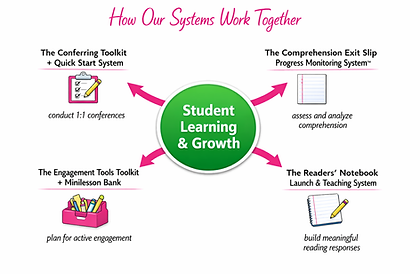
The Readers’ Notebook Launch & Teaching System™ gives you everything you need to start strong — from the first 10 days to reading identity lessons, notebook templates, reflection pages, and student tools.
If you want a calm, predictable way to help students make their thinking visible, this system is for you.
👉 Explore the Readers’ Notebook Launch & Teaching System™


Comments